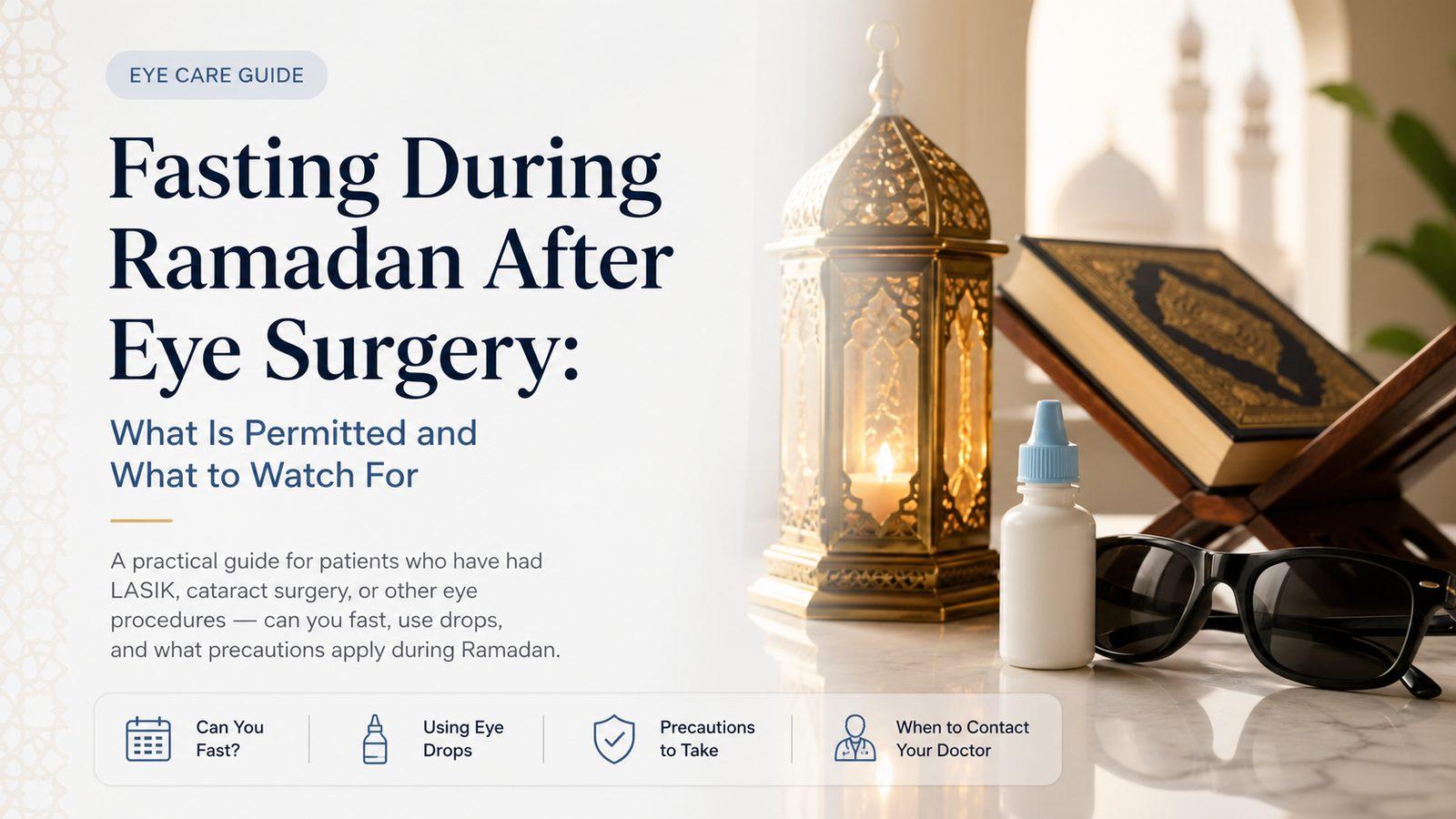
Every year as Ramadan approaches, our clinics receive a surge of questions from patients who have recently had eye surgery or are planning to: "Can I fast? Do eye drops break my fast? Can I have surgery during Ramadan?" This guide addresses the medical and practical dimensions.
Do eye drops break the fast?
This is the most common question. The majority scholarly opinion in Islamic jurisprudence — including fatwas from Dar al-Ifta in Oman, Egypt, and Saudi Arabia — is that eye drops do not break the fast, because:
- The eye is not a natural body opening (mouth, nose) through which substances are intentionally consumed.
- Trace amounts that reach the pharynx via the nasolacrimal duct are considered incidental, not consumptive.
Our recommendation: Continue all prescribed post-operative eye drops exactly as directed. Missing drops to preserve a fast is medically risky and, under the dominant jurisprudential ruling, unnecessary. If in doubt, consult your religious authority — but bring the drops and show them; most will rule drops are permitted.
Practical tip: Nasolacrimal occlusion — gentle pressure on the inner corner of the eye for 2 minutes after instillation — reduces systemic absorption and the amount reaching the pharynx.
After LASIK
Can I fast?
Yes, fasting does not affect corneal healing directly. However:
- Dehydration worsens post-LASIK dry eye significantly. Ensure adequate hydration at suhoor and iftar — minimum 2 litres between iftar and suhoor.
- Artificial tears are permitted during fasting (see above) — use them frequently.
- Avoid very dry A/C environments during fasting hours if possible.
Timing surgery around Ramadan
If you can schedule LASIK 4–6 weeks before Ramadan, most patients are beyond the critical healing period before fasting begins. If surgery is in the 2 weeks before Ramadan, the post-op drop schedule during Ramadan is straightforward and compatible with fasting.
After cataract surgery
Cataract surgery patients are typically on a steroid + antibiotic drop schedule for 4–6 weeks post-op. All these drops are permitted during fasting. Continue the prescribed schedule.
The main consideration: miotics (drops that constrict the pupil) — sometimes used in cataract surgery follow-up — can cause brow ache and photophobia. In Ramadan, the late-night prayer activities and increased light exposure can be uncomfortable. Discuss with your surgeon if this applies.
After retinal injections (anti-VEGF)
Retinal injection patients receiving monthly anti-VEGF injections can continue during Ramadan without modification. There is no dietary interaction. Injections are medical procedures, not nutritional intake, and do not break the fast.
Planning surgery during Ramadan
We do perform elective eye surgery during Ramadan with several adaptations:
- Surgery is scheduled early morning before the heat of the day.
- IV sedation is generally avoided for LASIK (already done under topical anaesthesia only); general anaesthesia patients should discuss fasting rules with the anaesthetist — these rules are well established.
- We adjust the post-op instructions to account for the Ramadan schedule.
Common mistakes to avoid
- Stopping drops during fasting hours — this is both medically risky (infection, inflammation) and jurisprudentially unnecessary under mainstream rulings.
- Reducing hydration too much — particularly dangerous for dry eye and post-LASIK patients.
- Sleeping through the post-op drop schedule because of reversed sleep — set phone alarms.
- Driving to tarawih prayers immediately after LASIK — Night driving restrictions apply until cleared by your surgeon, Ramadan or not.
Ready to Learn More?
Schedule a consultation with our expert team to discuss your vision care options and find the best solution for your eyes. Read next: Preparation guides for eye surgery.