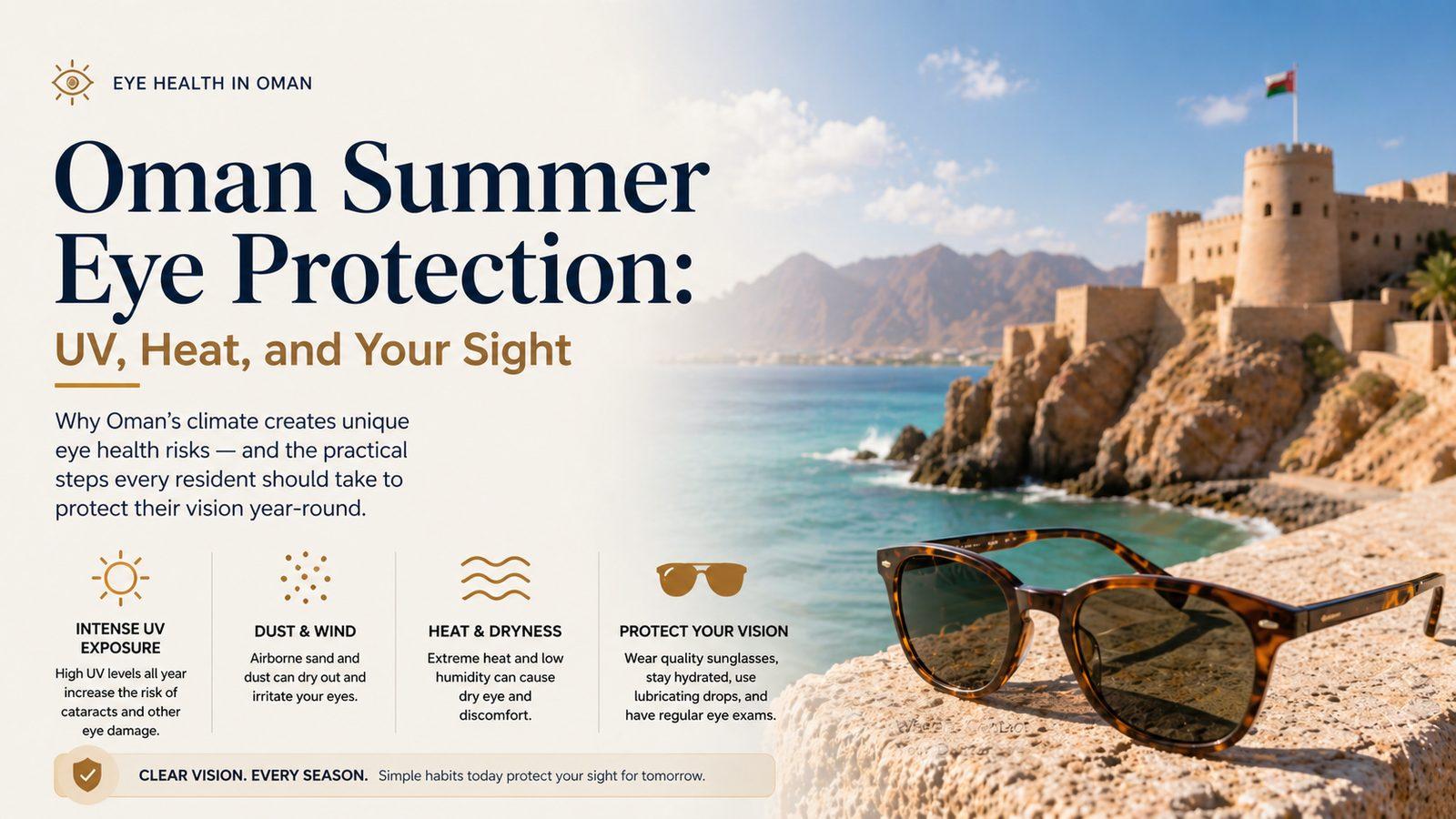
Oman sits between latitudes 16° and 26° North — almost exactly in the subtropical UV maximum zone. In July and August, the UV Index in Muscat regularly reaches 11–12 (the WHO "extreme" category), and the combination of UV, sand, dust, heat, and dry air creates an eye health environment unlike almost anywhere else in the world.
UV: the invisible threat
What UV does to your eyes
- Photokeratitis (sunburn of the cornea): painful, temporary, can occur after a day at the Muscat beach or Salalah during Khareef. Symptoms: red, watering eyes, extreme light sensitivity, 6–12 hours after exposure.
- Pterygium: a wedge of fibrous tissue growing over the cornea from the nasal side. Common in Oman, directly linked to lifetime UV exposure. Treated surgically when it threatens vision or causes persistent redness.
- Cataract: UV is the second most important modifiable risk factor after age. WHO estimates that 5–20% of cataracts are directly attributable to UV exposure.
- Age-related macular degeneration: chronic UV accelerates oxidative damage in the RPE.
- Conjunctival intraepithelial neoplasia (CIN): UV-related squamous cell changes on the conjunctiva — more common in Gulf countries than Europe.
Choosing the right sunglasses
UV protection (non-negotiable)
All sunglasses sold in Oman should meet CE EN ISO 12312-1 or equivalent. Look for "UV400" or "100% UVA/UVB" — this means protection up to 400 nm. Tint darkness is irrelevant for UV protection; clear lenses can block 100% UV if coated correctly. Dark lenses without UV coating are actually worse than no sunglasses (dilated pupils let in more UV).
Category 3 or 4 lens
For outdoor use in Oman, Category 3 (transmittance 8–18%) is minimum. Category 4 (transmittance 3–8%) is appropriate for desert driving — but not for driving in tunnels (Category 4 is illegal for driving in some jurisdictions).
Wraparound frames
UV enters from the sides. Wraparound or close-fitting frames block peripheral UV that standard frames miss.
Children and UV
Children's eyes have clearer lenses that transmit more UV to the retina — they accumulate proportionally more retinal UV damage per hour outdoors than adults. Quality UV-blocking sunglasses for children are essential from age 3 onwards, especially given Oman's UV levels.
Other summer eye hazards
Sand and dust
Fine sand particles can cause corneal abrasion. Wrap-around glasses or swimming goggles when driving in dusty conditions are sensible.
Air conditioning
Moving between 45°C outdoor air and 17°C A/C rooms hourly causes dramatic tear evaporation cycles. Carry preservative-free artificial tears and use them before entering heavily A/C-cooled environments.
Contact lenses in heat
Heat and dry air accelerate contact lens dehydration. Extended wear is riskier in summer — increase the number of daily lens changes or switch to daily disposables.
Ready to Learn More?
Schedule a consultation with our expert team to discuss your vision care options and find the best solution for your eyes. Read next: Eye care in Oman’s heat, sun and dust.