If your child was diagnosed with myopia at age 7 and you do nothing, their prescription at 18 could easily be -5.00 to -8.00 D — high enough to meaningfully increase lifetime risk of retinal detachment, glaucoma, and myopic macular degeneration. Myopia control is not about avoiding glasses. It is about protecting long-term eye health.
Why Oman is particularly high-risk
Studies from the Gulf region show myopia prevalence rising steeply — partly genetic predisposition in some populations, but mostly driven by the same indoor/screen time epidemic seen globally. Oman's climate means children spend more time indoors than European counterparts, reducing the protective effect of outdoor light.
What the evidence supports in 2026
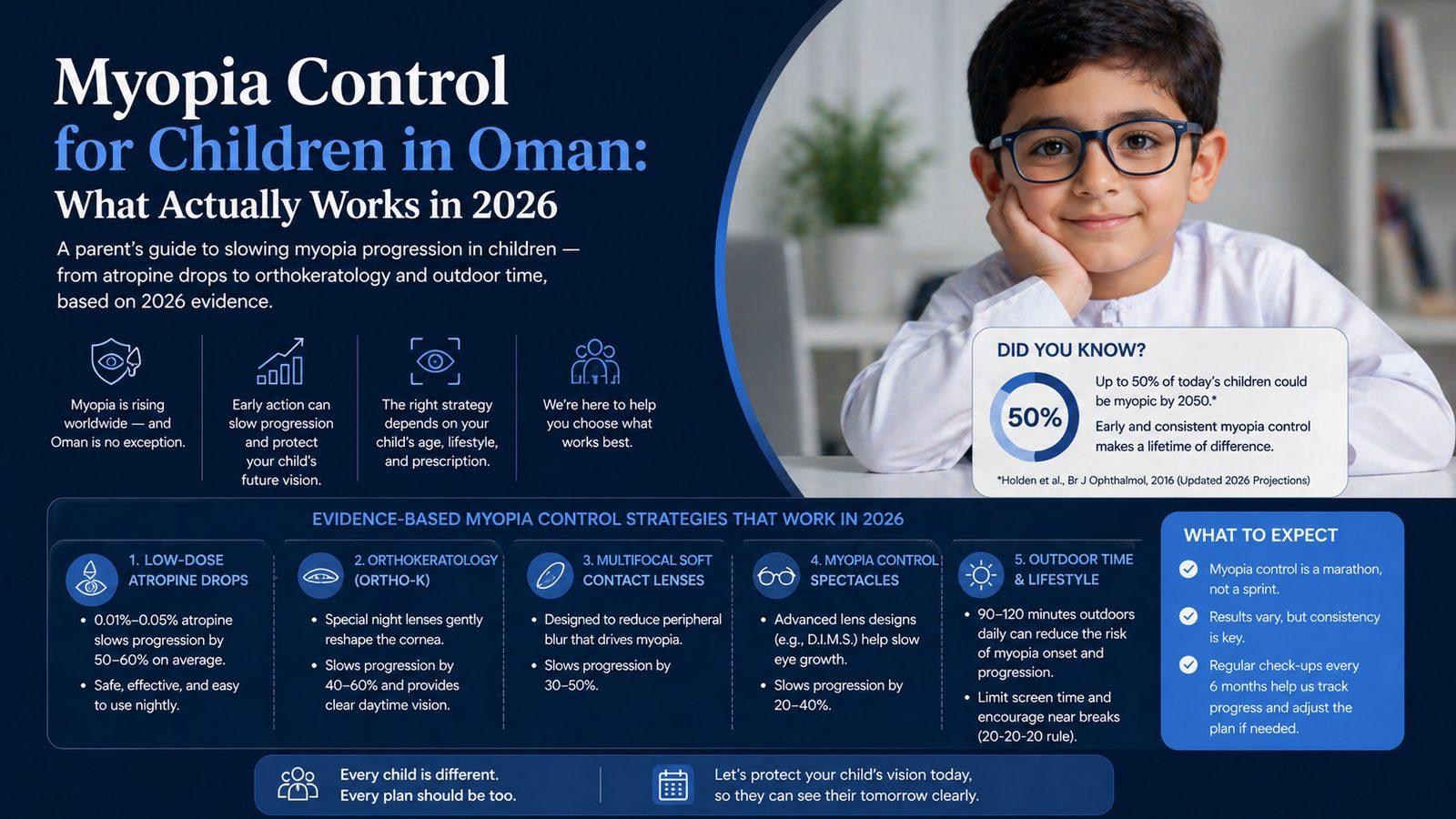
1. Low-dose atropine (0.025% or 0.05%)
Atropine eye drops, used nightly, are the single most evidence-backed myopia control intervention available. They slow axial eye elongation — the mechanism that drives prescription increases — by 50–70% compared to single-vision glasses.
How we use it at Finland Eye Center: We start at 0.025% (lower side-effects than the older 1% formulation: minimal pupil dilation, minimal near blur). Annual review; if progression is still > 0.5 D/year we step up to 0.05%.
Side effects: Mild light sensitivity (manageable with UV-blocking sunglasses outdoors). Very rare allergy.
2. Orthokeratology (Ortho-K)
Ortho-K lenses are worn overnight and gently reshape the corneal surface to provide clear daytime vision without glasses or contacts. The ortho-k effect also slows axial growth, with control rates comparable to low-dose atropine.
Best for: Children aged 8–15, cooperative with lens hygiene, motivated family. Requires monthly visits initially.
3. MiSight daily contact lenses
These are soft daily lenses with a peripheral defocus design that reduces the growth signal to the retina. Approved for myopia control, easier to manage than Ortho-K for younger children, less effective than atropine or Ortho-K but a good middle option.
4. Outdoor time
Two hours per day of outdoor time (not just physical activity — light intensity matters) reduces the risk of myopia onset by ~50% and slows progression once myopic. The mechanism is dopamine release in the retina triggered by bright light. This is the cheapest intervention and should be combined with everything else.
5. What does not work
- Standard single-vision glasses or contacts (correct vision but do not slow progression)
- Blue-light blocking glasses (no evidence for myopia control)
- Screen time limits alone (insufficient evidence as primary intervention)
Ready to Learn More?
Schedule a consultation with our expert team to discuss your vision care options and find the best solution for your eyes. Read next: Children's eye doctor in Oman: the full guide.