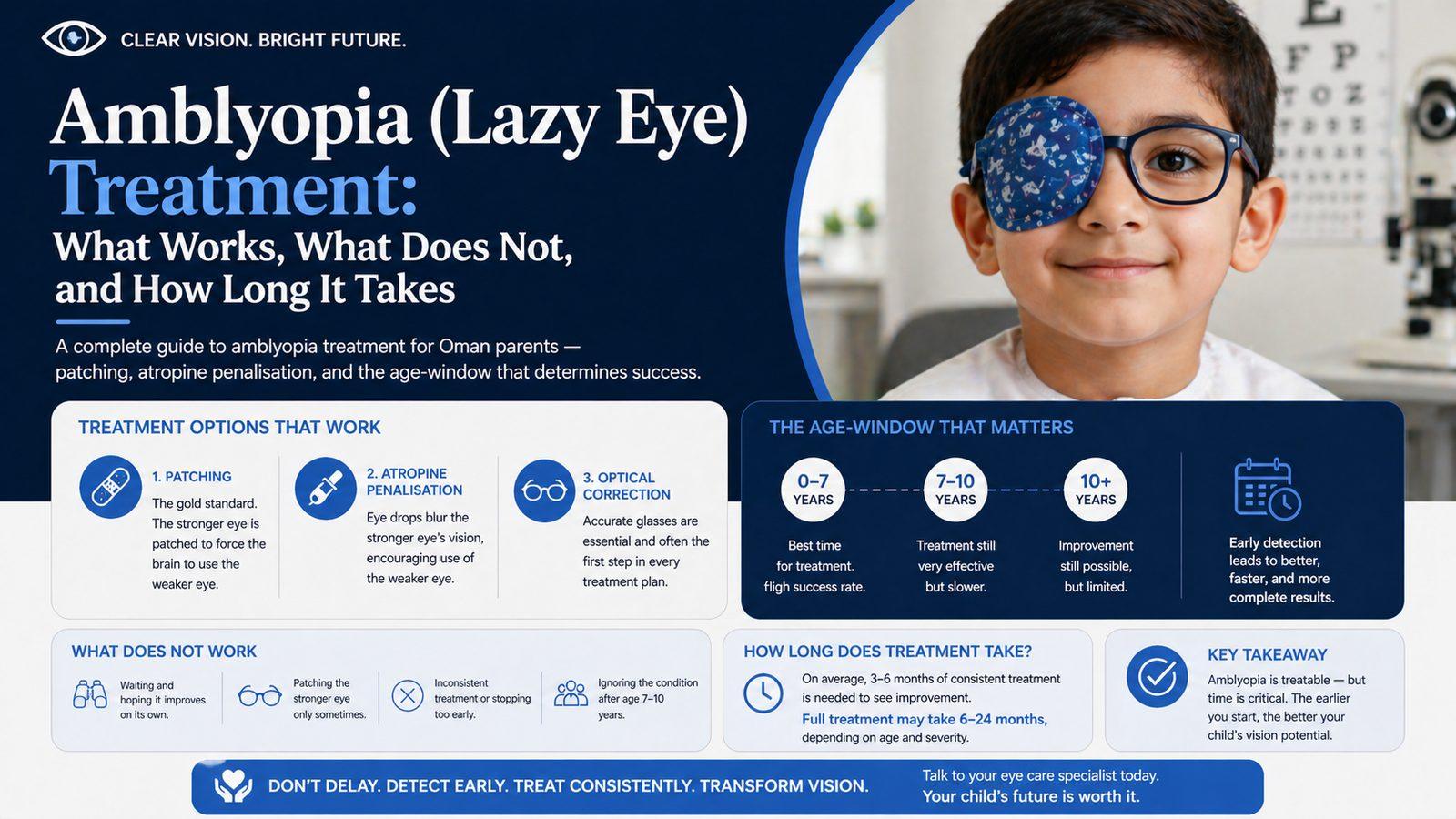
Amblyopia — commonly called "lazy eye" — is the most common cause of permanent, preventable vision loss in children worldwide. One in 50 children has it. In Oman, the combination of under-screened preschool populations and cultural hesitancy around patching means we see too many children who reach age 9 or 10 when treatment is much harder.
What amblyopia actually is
Amblyopia is not a problem with the eye itself — it is a problem with the brain. The visual cortex, during its critical development window (roughly birth to age 7–9), receives a blurry or misaligned image from one eye. The brain, rather than processing two conflicting images, suppresses the weaker eye. The neurons that serve that eye literally fail to develop properly. The eye looks normal on examination — but the vision is functionally poor.
Causes
- Anisometropia (one eye much more long-sighted or astigmatic than the other) — most common, and often invisible to parents since the child seems to see normally
- Strabismus (squint) — the deviating eye is suppressed
- Visual deprivation — congenital cataract, ptosis, anything blocking the visual axis
The age window: why urgency matters
- Age 0–7: Best treatment response. Amblyopia treated at age 4–5 can often achieve normal or near-normal vision.
- Age 7–10: Harder but still possible. Requires more intense treatment, longer duration.
- Age 10–17: Reduced but real treatment response, especially for milder cases. Worth treating.
- Adult: Very limited response to traditional patching. Newer dichoptic training (binocular iPad games) show some benefit in trials.
Treatment options
1. Glasses first
Most anisometropic amblyopia improves substantially with the correct spectacle correction alone, given 3–4 months of consistent wear. This is always step one — never skip to patching without a current glasses trial.
2. Patching (occlusion therapy)
Patch the good eye to force the brain to use the amblyopic eye. Duration: 2–6 hours per day, typically for months to years depending on severity and age. Compliance is the primary challenge — the child does not like it because the patched vision is worse.
Our tips for compliance in Oman:
- Decorate patches (especially for girls — patterned fabric covers help)
- Schedule patching for a specific activity the child enjoys (video games, favourite shows)
- Reward charts work for ages 3–7
- Involve the school teacher so patches are not removed at school
3. Atropine penalisation
Instead of a physical patch, one drop of atropine in the good eye blurs it, forcing brain use of the amblyopic eye. As effective as patching for mild-to-moderate amblyopia, with better compliance. The good eye is blurred for near vision only — the child can still see distance.
4. Dichoptic digital therapy (newer)
Computer games and tablet apps designed to present different images to each eye simultaneously, training binocular cooperation. Still emerging but promising for older children who have failed traditional approaches.
Ready to Learn More?
Schedule a consultation with our expert team to discuss your vision care options and find the best solution for your eyes. Read next: Children's eye doctor in Oman: the full guide.