Cataract surgery has a secret: removing the cloudy lens is the straightforward part. The consequential decision — the one that will shape your vision for the rest of your life — is which replacement lens goes in. In Oman, where patients range from pearl fishers to engineers to avid readers, the right lens is deeply personal.
The basic choice: monofocal vs premium lenses
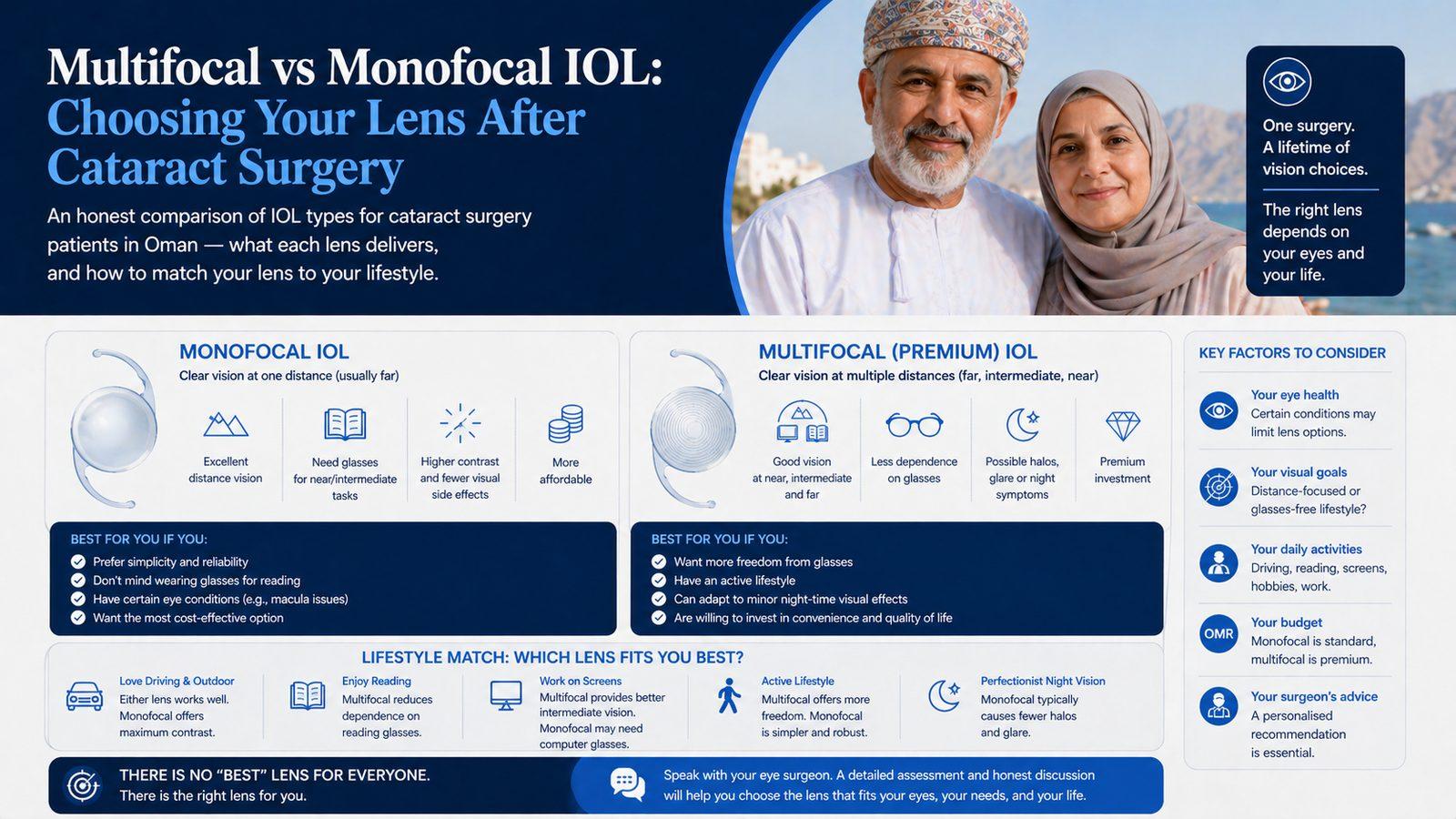
Monofocal IOL
A single focal point — set at distance, intermediate, or near. Most patients choose distance focus and accept reading glasses for close work. This is the standard IOL covered by most insurance plans.
Pros: Sharp distance vision, predictable outcome, lowest cost, best contrast sensitivity, fewest halos/glare.
Cons: You will need reading glasses. No intermediate vision (computer distance).
Extended Depth of Focus (EDOF)
A newer technology that stretches the focal range from distance to intermediate, with decent near vision. Fewer halos than trifocal.
Best for: Patients who drive at night frequently and want reduced halos, but also want some freedom from glasses for computer work.
Trifocal IOL
Three focal points: distance, intermediate (60–80 cm), and near (30–40 cm). The premium lens that offers the most glasses independence.
Pros: Most patients read menus, use phones, and drive without glasses.
Cons: Higher cost than a monofocal lens; you get a quote after your assessment. Halos and starbursts around night lights are real and typically take 3–6 months to neuroadapt. In some cases they do not fully resolve.
Toric IOL
Any of the above with built-in astigmatism correction. Essential if your corneal astigmatism is > 1.0 D — without toric correction, even a perfect cataract surgery will leave blurry distance vision.
How to choose
- Night driver + perfectionist about halos → Monofocal or EDOF
- Reader/screen user who wants glasses freedom → Trifocal
- Active outdoor life, not much reading → EDOF
- Astigmatism > 1.0 D → Add toric to any of the above
- Macular degeneration or other retinal disease → Monofocal only (premium lenses reduce contrast which is already compromised)
Ready to Learn More?
Schedule a consultation with our expert team to discuss your vision care options and find the best solution for your eyes. Read next: Cataract surgery in Oman: the full guide.