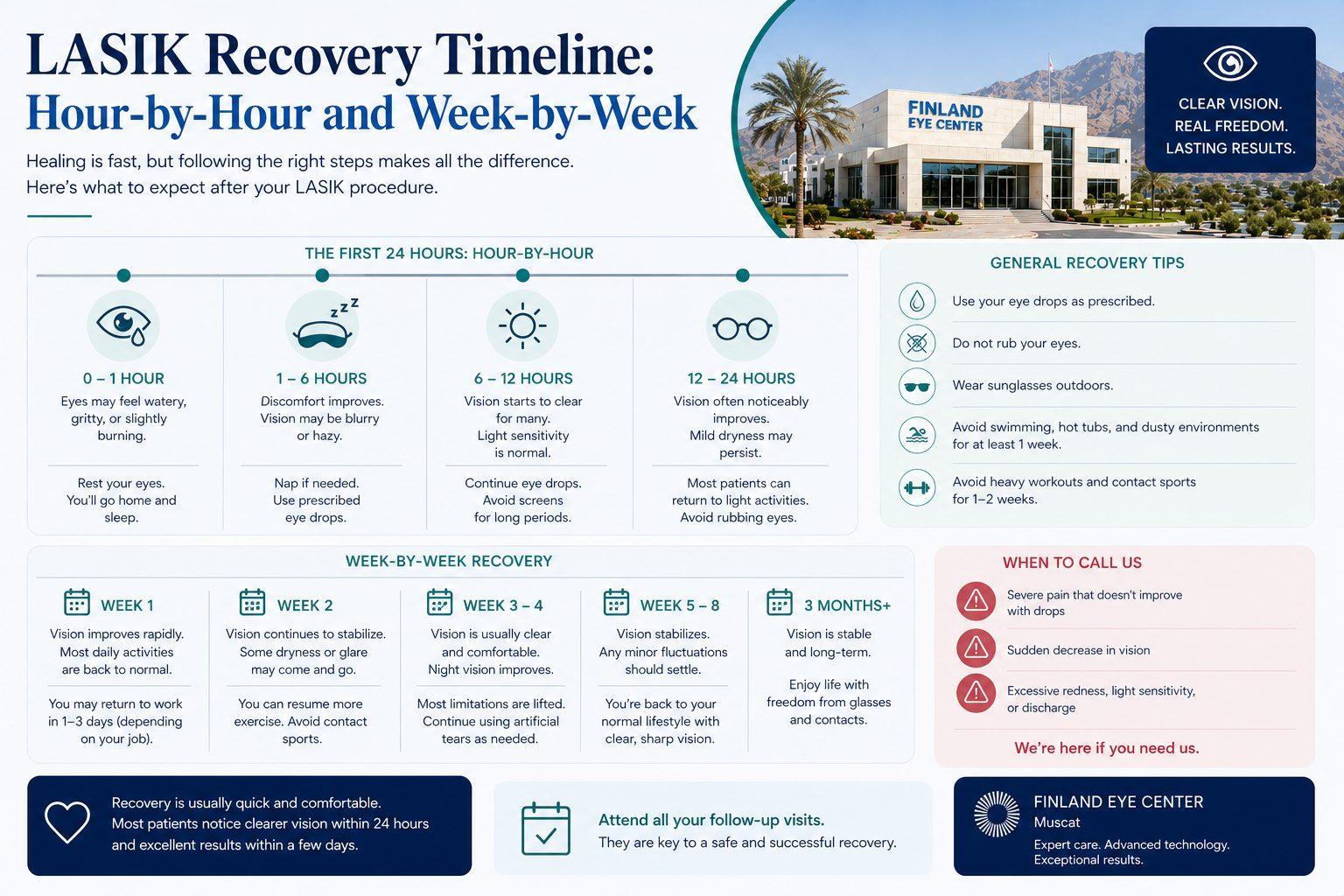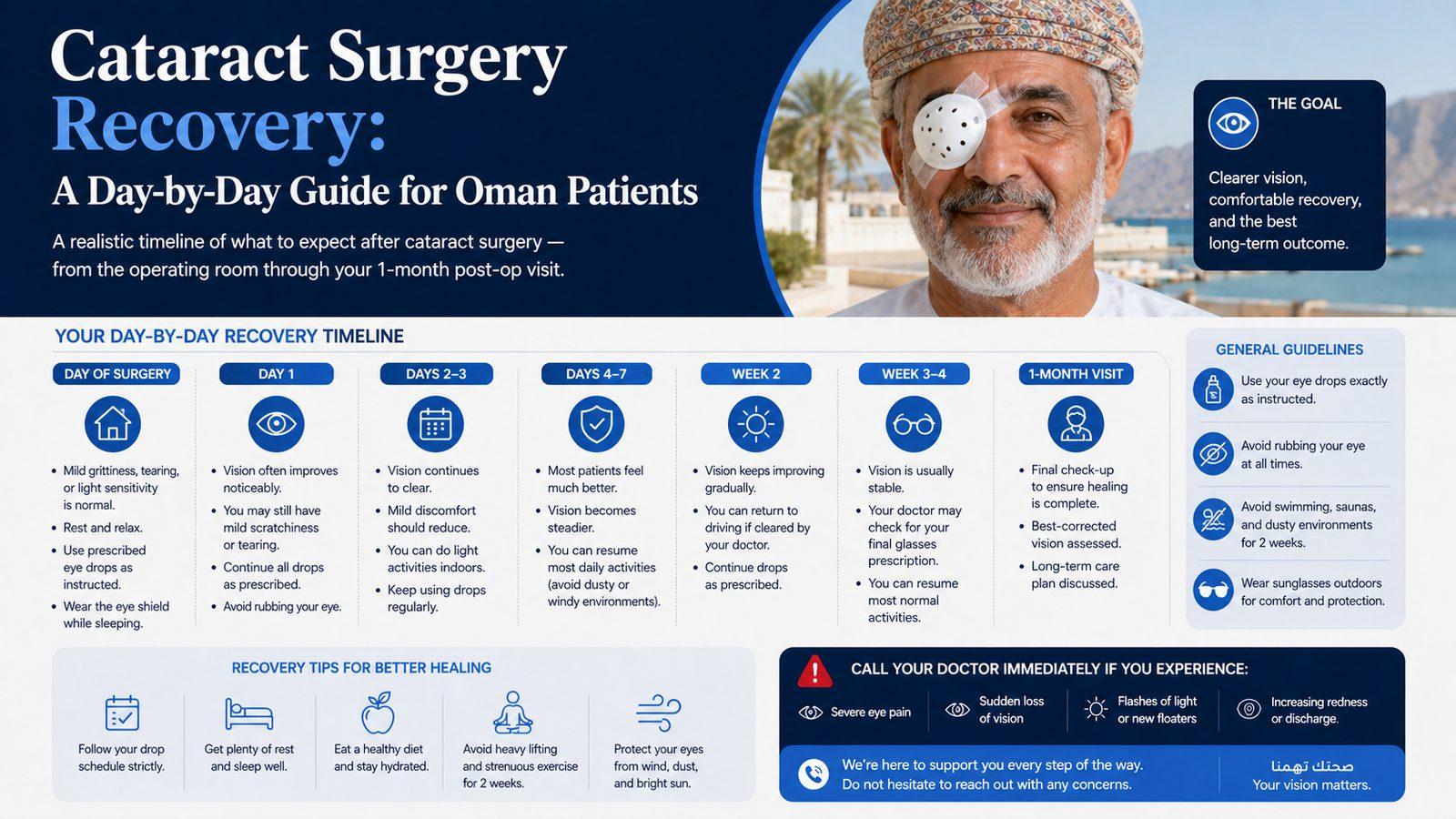
Cataract surgery is the most commonly performed operation in the world — and one of the safest. But "common" does not mean "trivial." Your new lens needs to settle, your eye needs to heal, and your brain needs to adapt to seeing colour and contrast it has not experienced in years. Here is what to expect.
The operating room and recovery area (Day 0)
The procedure takes 10–20 minutes per eye under local anaesthesia (eye drops, no needles in most cases). You are awake the whole time. You may see lights and movement but not the surgical instruments.
After surgery, you rest for 30–60 minutes in our recovery area. You will go home with:
- A transparent shield taped over the eye
- Prescription eye drops (antibiotic + anti-inflammatory)
- Written instructions
You need a driver. Do not drive on surgery day under any circumstances.
Day 1: The shield comes off
Your 1-day check is usually the morning after surgery. We remove the shield, check pressure and wound integrity, and measure your uncorrected vision.
Day 1 vision varies: many patients with a monofocal distance lens already see more clearly, and vision keeps improving over the following weeks.
What is normal on Day 1:
- Mild redness around the white of the eye
- Feeling of grittiness or mild irritation
- Colours appear brighter and bluer — the cataract was filtering out blue light for years
- Mild light sensitivity
Days 2–7: Settling in
- Continue drops exactly as prescribed (usually 4x daily antibiotic, 4x daily steroid)
- Wear the shield to sleep for 1 week
- No rubbing
- No swimming or dusty environments
- Reading and TV are fine from Day 2
- Driving: cleared after the 1-week visit if vision meets minimum standards
Weeks 2–4: Near-normal life
Most patients resume all normal activities. Final spectacle prescription is not stable yet — wait for the 4–6 week visit before ordering new glasses.
When to call us immediately
- Sudden loss of vision
- Severe pain (mild irritation is normal; pain is not)
- Increasing redness after Day 3
- Flashing lights or a new floater curtain (retinal detachment warning)
Ready to Learn More?
Schedule a consultation with our expert team to discuss your vision care options and find the best solution for your eyes. Read next: Cataract surgery in Oman: the full guide.