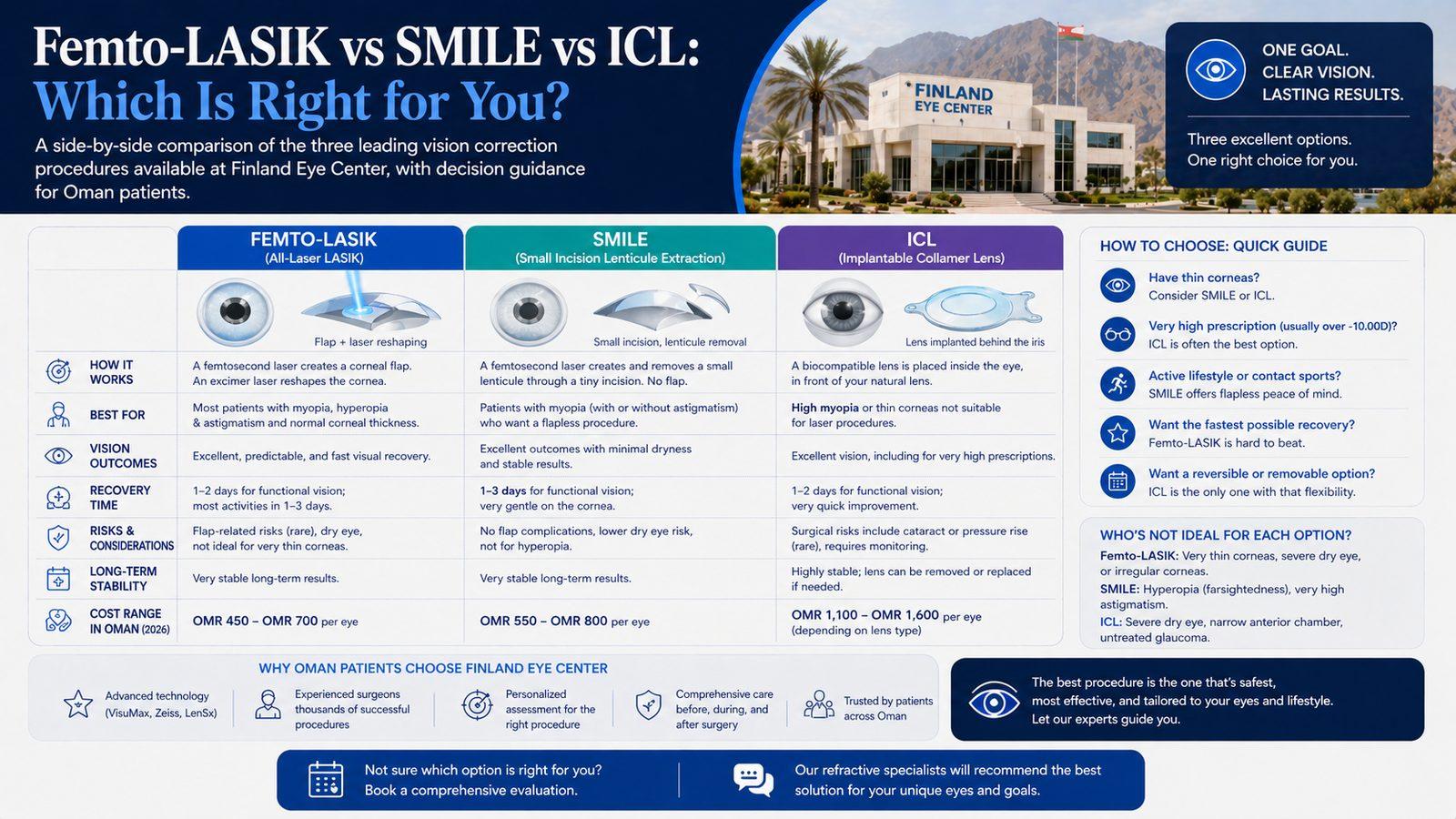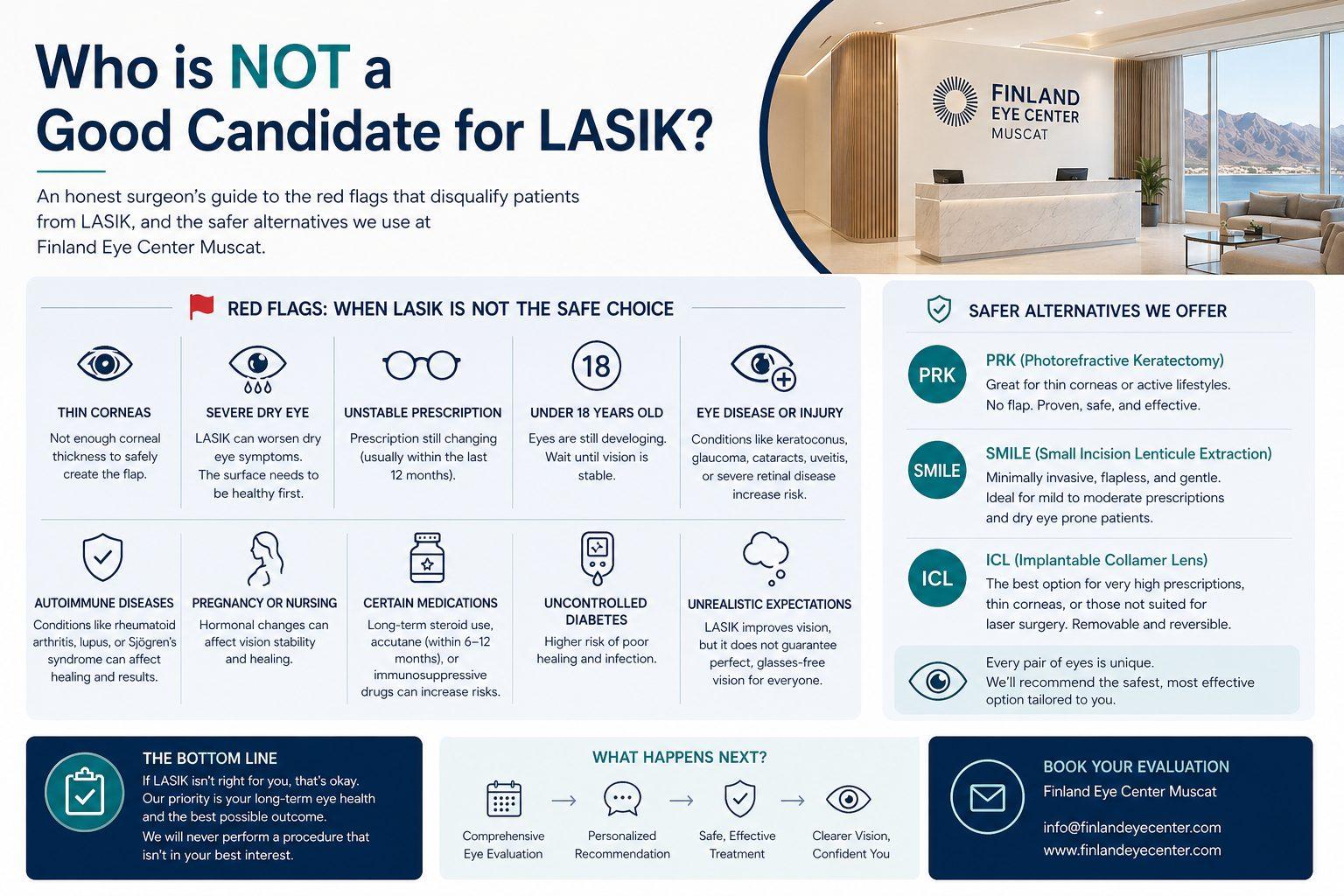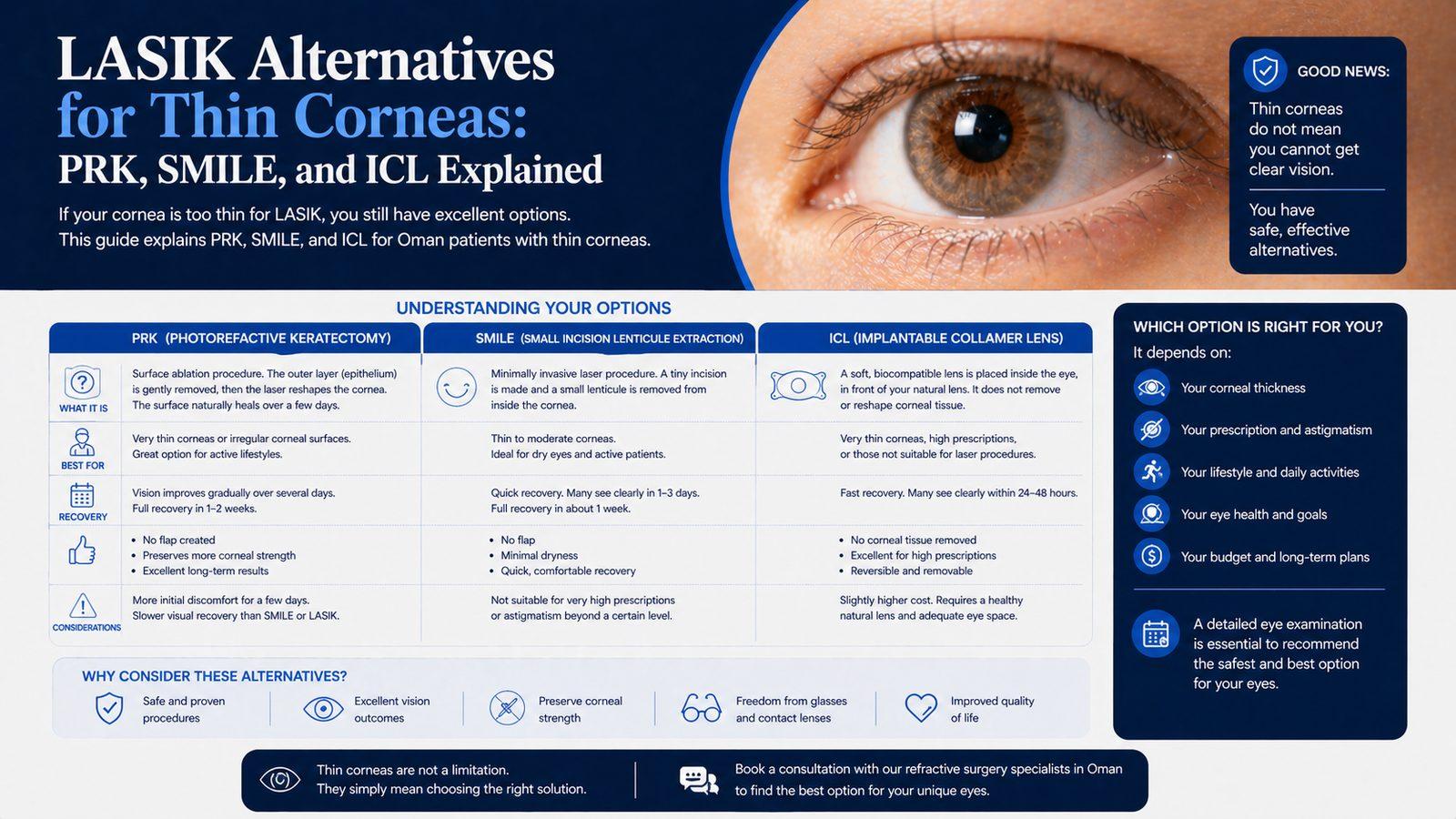
Being told your cornea is too thin for LASIK feels like a dead end. It is not. In 2026, patients with thin corneas have three refractive surgery options — PRK, CLEAR, and ICL — each with distinct advantages depending on your prescription, lifestyle, and corneal anatomy.
What does "thin cornea" actually mean?
A normal cornea is approximately 540–560 micrometres (μm) thick at the centre. LASIK requires removing tissue (ablation) while leaving a safe residual stromal bed of at least 300 μm. If your cornea is 480 μm and your prescription needs 180 μm of ablation, the math does not work.
Screening at Finland Eye Center uses Pentacam (anterior + posterior elevation), pachymetry maps, and Belin-Ambrósio enhanced ectasia analysis to determine safe candidacy precisely.
Option 1: PRK (PhotoRefractive Keratectomy) / TransPRK
PRK removes the surface epithelium and reshapes the stroma directly — no flap, so no flap-related residual bed concern. The same ablation depth in a 480 μm cornea is safer in PRK than LASIK because the epithelium regenerates and you do not need to account for flap thickness (90–110 μm in LASIK).
Who it suits: Thin corneas with prescriptions up to about -8 D. Patients with high-impact jobs or hobbies (military, boxing, rugby) who cannot risk a flap in trauma.
The trade-off: Slower recovery. PRK patients have real pain and blurry vision for 3–5 days (the epithelial healing period), and best-corrected vision takes 4–6 weeks to stabilise. Plan accordingly.
Option 2: CLEAR (lenticule extraction)
CLEAR, the lenticule extraction procedure by Ziemer used at Finland Eye Center, removes a lenticule of stroma through a tiny incision, leaving the anterior 100–120 μm of cornea completely intact. For thin corneas, this means a deeper safe window compared to LASIK.
Who it suits: Myopia up to -10 D. Active lifestyle. Dry-eye-prone patients (lenticule extraction cuts fewer corneal nerves than LASIK).
Limitation: Not available for hyperopia; limited astigmatism range.
Option 3: ICL (Implantable Collamer Lens)
ICL adds a corrective lens inside the eye without touching the cornea at all. It is the only option that works for very high prescriptions (-10 to -18 D) and the only one that is fully reversible.
Who it suits: Any thin cornea. High myopia. Patients with dry eye. Patients who want a future-proof, reversible option.
The trade-off: It is intraocular surgery — higher stakes than surface procedures. Requires an intact endothelium and adequate anterior chamber depth. Annual IOP check recommended.
Ready to Learn More?
Schedule a consultation with our expert team to discuss your vision care options and find the best solution for your eyes. Read next: LASIK or ICL: which suits you?.