
Comprehensive Eye Care
Corneal Cross-Linking (CXL) — Patient Guide
Back to Guides

Corneal Cross-Linking (CXL) — Patient Guide

How to prepare for corneal cross-linking (CXL), what happens on the day, and the eye drops, recovery and follow-up afterwards.

302 views

Important Information

Please read this guide carefully and follow your doctor's instructions, which come first if they differ from this guide. If you have any questions, don't hesitate to contact our medical team.

Before Surgery

Important preparation steps

Before your CXL procedure: • Confirm your appointment time and location • Arrange transportation - you should not drive after the procedure • Continue taking any regular medications unless instructed otherwise • Remove contact lenses at least 24 hours before the procedure • Eat a light meal before coming to the center • Bring sunglasses for after the procedure

During Surgery

What happens during the procedure

During the procedure: • Arrive 30 minutes before your scheduled procedure time • The procedure is performed under topical anesthesia (eye drops) • The epithelium (surface layer of cornea) may be removed or kept depending on technique • Riboflavin (Vitamin B2) drops are applied to the cornea • UVA light is applied to activate the riboflavin for approximately 30 minutes • Antibiotic eye drops are given • A soft bandage contact lens is placed to aid healing • Protective eyeglasses will be provided • The entire procedure takes approximately 60 minutes

After Surgery

Care and recovery

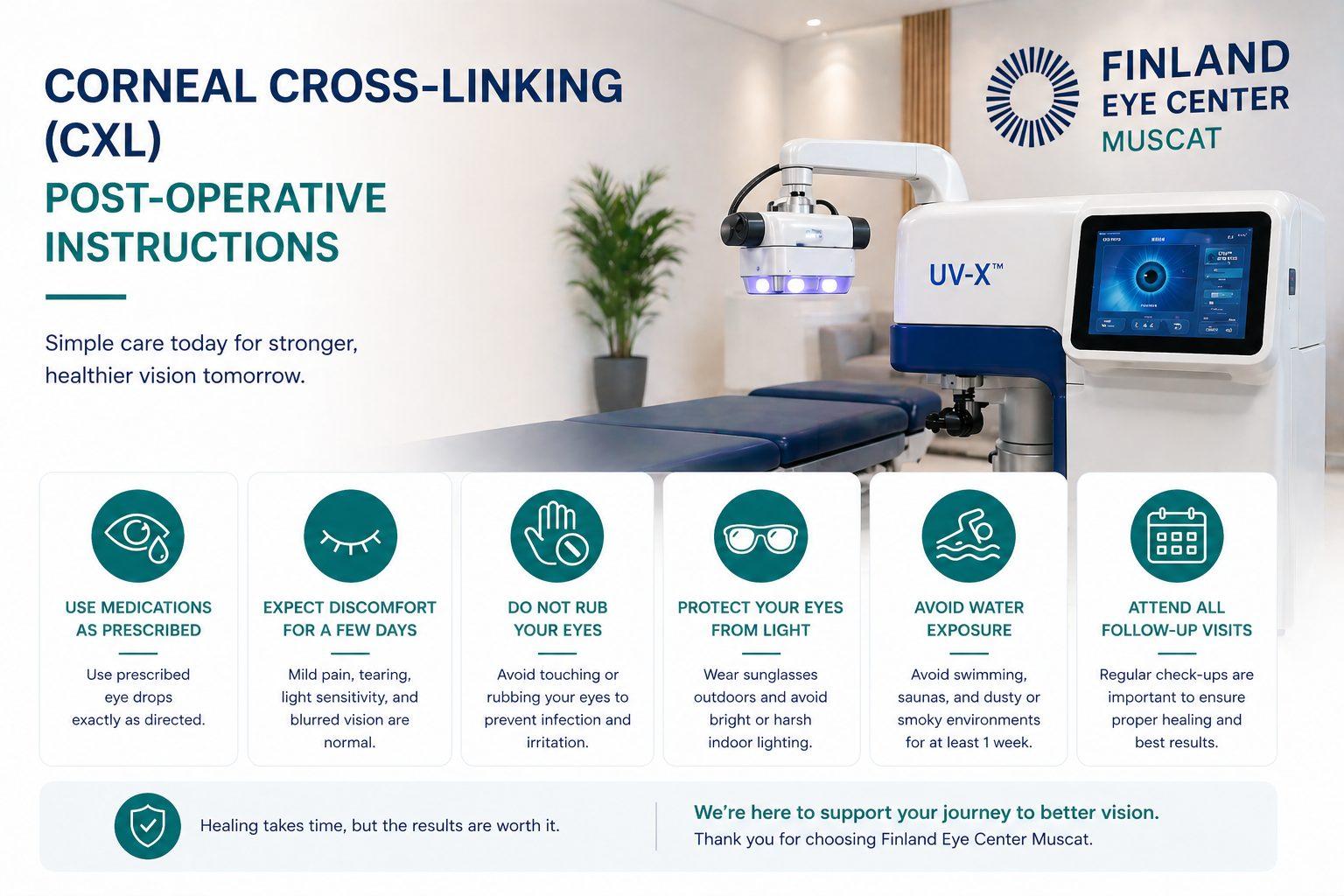
POST-OPERATIVE REFRACTIVE SURGERY - CXL / PTK Eye Drop Instructions (Tymer): • Every 2 hours for first day, then twice daily for a week OPTIVE Instructions: • Every 2 hours for first day, then 4 times daily for 2 months OPTILONE Instructions: • 3 times daily for first month • 2 times daily for second month • 1 time daily for third month Important Post-Op Guidelines: • Use goggles for 3 days after surgery, then sunglasses outside • Don't rub your eyes • Take shower next day without rubbing eyes - prevent soap from getting in eyes • You can do Sujud next day of surgery • Don't use eye makeup for one week • You can use mobile phone and watch TV next day • Go back to sports after one week, other sports (football - combat sports) after one month • Avoid swimming in sea/pool for one month • Don't sit indoors with Bukhur and perfumes for one week • Don't use colored contact lenses for 3 months • Avoid driving at night during first week of surgery

What to Expect

Expected outcomes

What to Expect from CXL: Immediate Effects (First Week): • Mild to moderate discomfort • Light sensitivity • Watery eyes • Blurred vision • Feeling of something in your eye Short-term Recovery (1-4 Weeks): • Gradual improvement in comfort • Vision may fluctuate • Reduced light sensitivity • Return to most daily activities Long-term Outcomes (3-12 Months): • Stabilization of keratoconus progression • Potential improvement in corneal shape • Some patients experience improved vision • The cornea becomes stronger and more resistant to further changes How CXL Works: • CXL aims to halt keratoconus progression • The procedure strengthens the cornea by increasing collagen bonds • Effects are long-lasting, though some patients may need retreatment after several years

Do's and Don'ts

Essential guidelines for recovery

Do's

  • Use Tymer drops every 2 hours first day, then twice daily for a week
  • Use OPTIVE drops every 2 hours first day, then 4 times daily for 2 months
  • Use OPTILONE 3 times daily first month, 2 times second month, 1 time third month
  • Wear protective goggles for 3 days after surgery
  • Use sunglasses when outside
  • You can do Sujud next day
  • You can use mobile and watch TV next day
  • Return to sports after one week

Don'ts

  • Don't rub your eyes
  • Don't use eye makeup for one week
  • Don't play contact sports (football, combat sports) for one month
  • Don't swim in sea/pool for one month
  • Don't sit with Bukhur and perfumes indoors for one week
  • Don't use colored contact lenses for 3 months
  • Don't drive at night during first week

Recovery Timeline

What to expect during recovery

First Few Days
Discomfort, tearing, blurred vision. Bandage lens removed after epithelium heals (4-7 days)
First Week
Gradual improvement in comfort. Use all prescribed eye drops as directed
First Month
Possible temporary decrease in vision - this is normal. Continue OPTIVE and OPTILONE drops
2-3 Months
Continue OPTIVE drops 4 times daily. Reduce OPTILONE as prescribed
3-12 Months
Final results become apparent, vision stabilizes

Frequently Asked Questions

Answers to common questions

QHow long does the CXL procedure take?

The entire procedure typically takes 60-90 minutes, including preparation time. The actual UV light exposure portion lasts about 30 minutes.

QIs CXL painful?

The procedure itself is not painful due to anesthetic drops. However, you may experience discomfort for 3-5 days after the procedure as your eye heals. Pain medication and prescribed eye drops help manage this discomfort.

QWhen can I return to work after CXL?

Most patients can return to work within 3-7 days, depending on their job requirements and individual healing. Jobs requiring extensive computer use or detailed visual work may require a longer recovery period.

QWill CXL improve my vision?

CXL is primarily designed to halt the progression of keratoconus, not improve vision. However, some patients do experience vision improvement over time as the cornea stabilizes and potentially flattens slightly.

QHow long do the effects of CXL last?

CXL effects are generally long-lasting. Studies show that the procedure successfully halts keratoconus progression for many years. However, a small percentage of patients may need retreatment after 5-10 years.

QCan I have CXL done on both eyes?

Yes, but the procedures are typically done separately, with at least 1-2 weeks between treatments to allow the first eye to heal before treating the second eye.

QWhat is the difference between epithelium-off and epithelium-on CXL?

Epithelium-off CXL involves removing the surface layer of the cornea for better riboflavin absorption, leading to stronger results but longer recovery. Epithelium-on CXL preserves this layer, offering faster recovery but potentially less effective strengthening. Your doctor will recommend the best approach for your case.