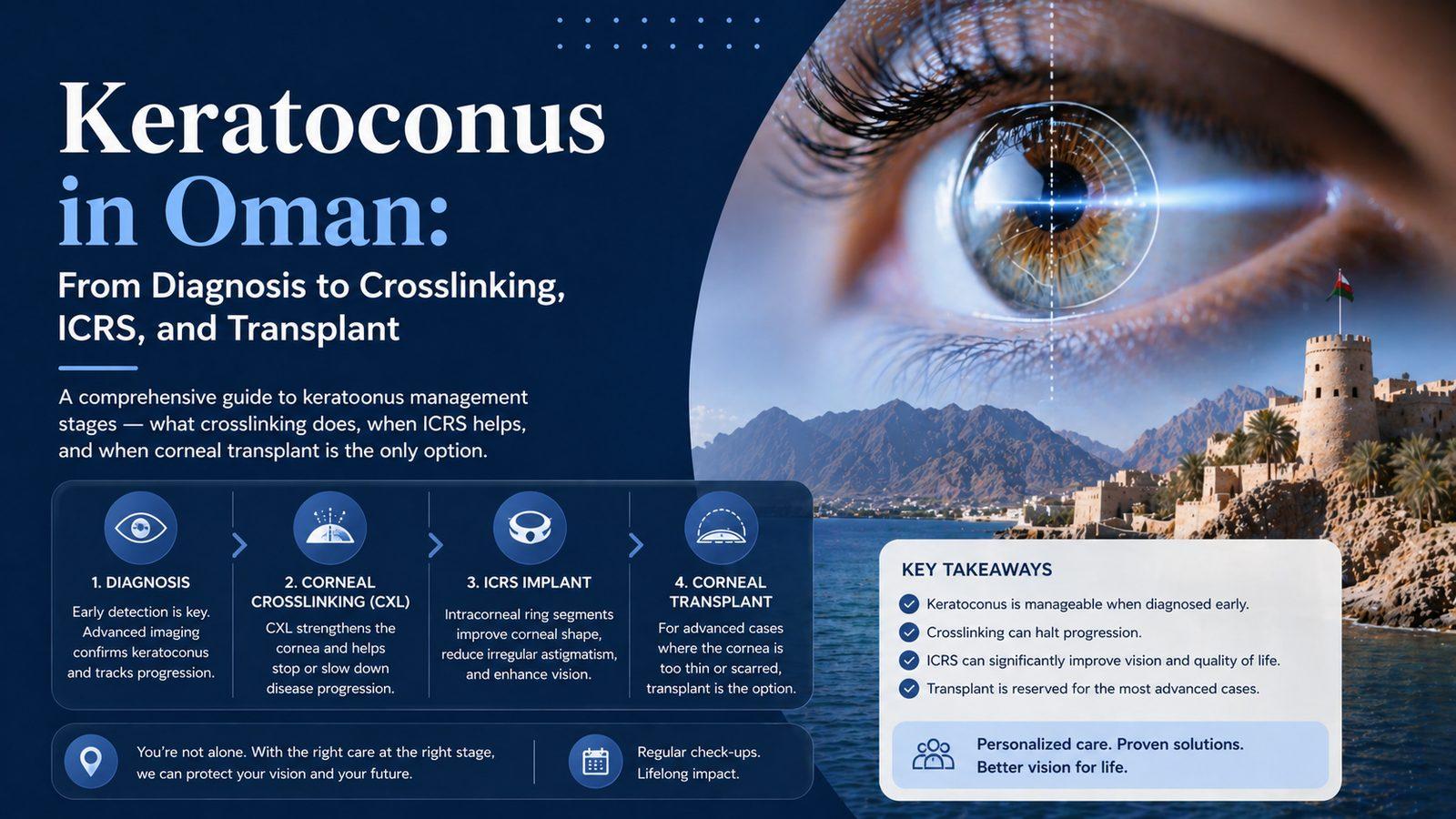
Keratoconus is a condition we see frequently in Oman — studies from Gulf countries show prevalence 3–5 times higher than in Europe, possibly related to eye rubbing habits (which are definitively associated with keratoconus progression) and genetic factors in the regional population. The good news: in 2026, most patients who are caught early can retain functional vision for life without transplant.
What keratoconus is
The cornea, instead of maintaining its dome shape, progressively thins and bulges forward in an irregular cone. This causes progressively worsening, irregular myopia and astigmatism that glasses correct poorly. At advanced stages, contact lenses are required for functional vision, and in end-stage disease, corneal transplant.
Diagnosis: what to expect
We diagnose and grade keratoconus using Pentacam (anterior + posterior elevation topography), which is more sensitive than older corneal topographers. The Amsler-Krumeich grading system classifies stages 1–4. The BAD-D (Belin-Ambrósio Deviation) index identifies subclinical cases (forme fruste) that standard tests miss.
Stage 1–2: Crosslinking (CXL) is the priority
Corneal crosslinking aims to stop keratoconus from progressing. It does not reverse existing distortion — it halts it. The procedure:
- Riboflavin (vitamin B2) drops applied to the de-epithelialised cornea for 30 minutes
- Ultraviolet-A light at 365 nm delivered for 30 minutes
- The UV activates riboflavin, creating new collagen bonds that stiffen the cornea
Recovery: The epithelium heals in 3–5 days (painful). Vision is blurry for 4–6 weeks during remodelling. Final stabilisation at 6–12 months.
Accelerated CXL (higher UV intensity, shorter time) is a variant of the same treatment; your doctor at Finland Eye Center explains which protocol suits your cornea.
Stage 2–3: ICRS (Intrastromal Corneal Ring Segments)
Small arc-shaped implants inserted into the corneal stroma to regularise the cone shape, flatten the steepening, and improve best-corrected vision. ICRS does not stop progression — it must be combined with CXL.
ICRS works best when: the cone is central, the BCVA is worse than 6/9, and contact lens tolerance has been lost. At Finland Eye Center, ring options include Keraring, MyoRing and Intacs; the design is chosen from your corneal topography.
Stage 3–4: Scleral contact lenses
Before transplant, scleral lenses vault over the irregular cornea and provide a smooth optical surface. Good scleral lens fitting can give many stage 3–4 patients clearer, more comfortable vision and can delay the need for a transplant.
End-stage: Corneal transplant
Two main options:
- DALK (Deep Anterior Lamellar Keratoplasty): replaces the diseased anterior stroma while leaving the patient's own endothelium. Preferred for keratoconus — no rejection of the endothelium, faster visual recovery.
- PK (Penetrating Keratoplasty): full-thickness transplant. Required if the endothelium is damaged.
Finland Eye Center offers DALK for keratoconus. Visual rehabilitation after DALK takes 12–18 months.
Ready to Learn More?
Schedule a consultation with our expert team to discuss your vision care options and find the best solution for your eyes. Read next: Keratoconus treatment in Oman: the full guide.