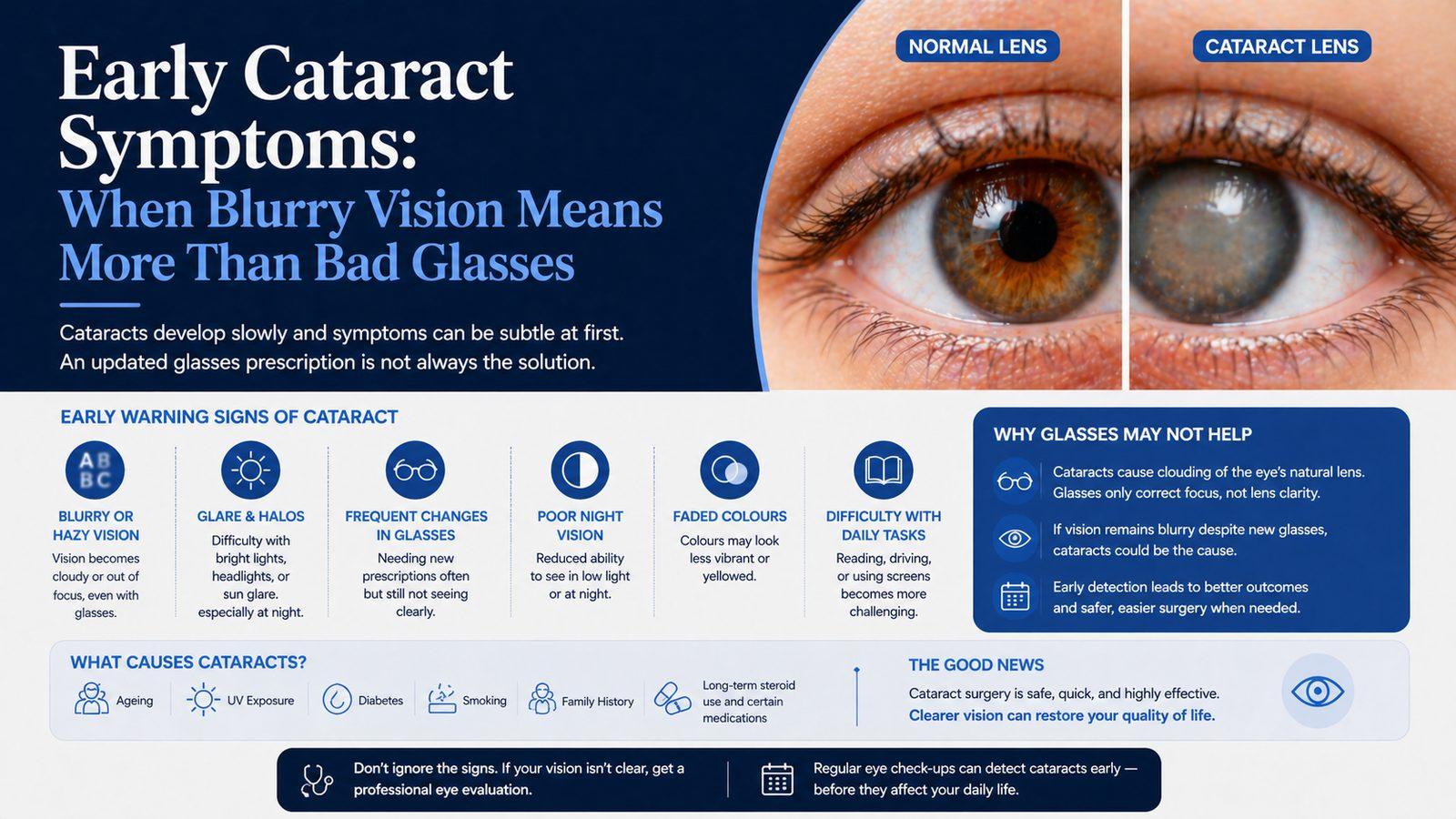
Most patients who eventually need cataract surgery do not arrive at our clinic saying "I think I have a cataract." They arrive saying "my glasses feel wrong" or "I cannot drive at night any more" or "the TV looks washed out." Recognising the pattern saves years of unnecessary glasses changes.
What is a cataract?
The natural lens of the eye is normally clear. Over time — accelerated by UV exposure, diabetes, steroid use, and genetics — proteins in the lens clump and scatter light instead of focusing it. The result is the classic "frosted glass" experience.
The 7 early symptoms
1. Blurred vision that glasses do not fix
This is the cardinal symptom. If your optician updates your prescription and the blur returns within weeks, the issue is likely inside the lens, not on the corneal surface.
2. Glare and halos around lights
Especially pronounced when driving at night. Oncoming headlights scatter into starbursts. Patients often stop night driving before they ever visit a clinic.
3. Colours appear faded or yellowed
The lens gradually takes on a brown/amber tint. You may not notice until after cataract surgery — when the world suddenly looks bright and blue again.
4. "Second sight" — sudden improvement in near vision
Counterintuitively, a nuclear cataract (affecting the core of the lens) can temporarily make the lens act like a reading magnifier. Patients who needed reading glasses for years suddenly find they can read without them. This improvement is temporary and reverses as the cataract matures.
5. Frequent prescription changes
If your glasses prescription changes by more than 0.5 D in under 12 months, especially in the sphere (not astigmatism), cataract should be ruled out.
6. Monocular diplopia (double vision in one eye)
A cataract can split the light focus, creating a ghost image. Covering the other eye does not make it go away — that is what distinguishes it from binocular (convergence) diplopia.
7. Difficulty with bright light
Some patients find bright sunlight or white backgrounds (like a computer screen against a window) intensely uncomfortable — the cataract scatters bright light diffusely.
When to come in
Any of these symptoms warrant a dilated fundus exam and slit-lamp assessment. We also measure the density of the cataract using the LOCS III grading system and assess whether it is reducing best-corrected visual acuity below 6/12 — the threshold we use alongside symptoms and patient impact for surgical planning.
Ready to Learn More?
Schedule a consultation with our expert team to discuss your vision care options and find the best solution for your eyes. Read next: Cataract surgery in Oman: the full guide.